Entfaltung
Entfaltung is German for unfolding. I begin with the pendulum drawings of Swiss healer-artist Emma Kunz (1892–1963) and unfold them out of the flat page into space and time. What Kunz fixed on graph paper, I set in motion. It is a living drawing, computed in real time. I pre-render nothing, and it never repeats.
The process
Arriving at the final work took me four stages, each one building on the one before it, and I am still developing it.
- Emulation. I rebuild Kunz’s radial constructions in code. My program re-executes how she drew, rather than copying what she drew.
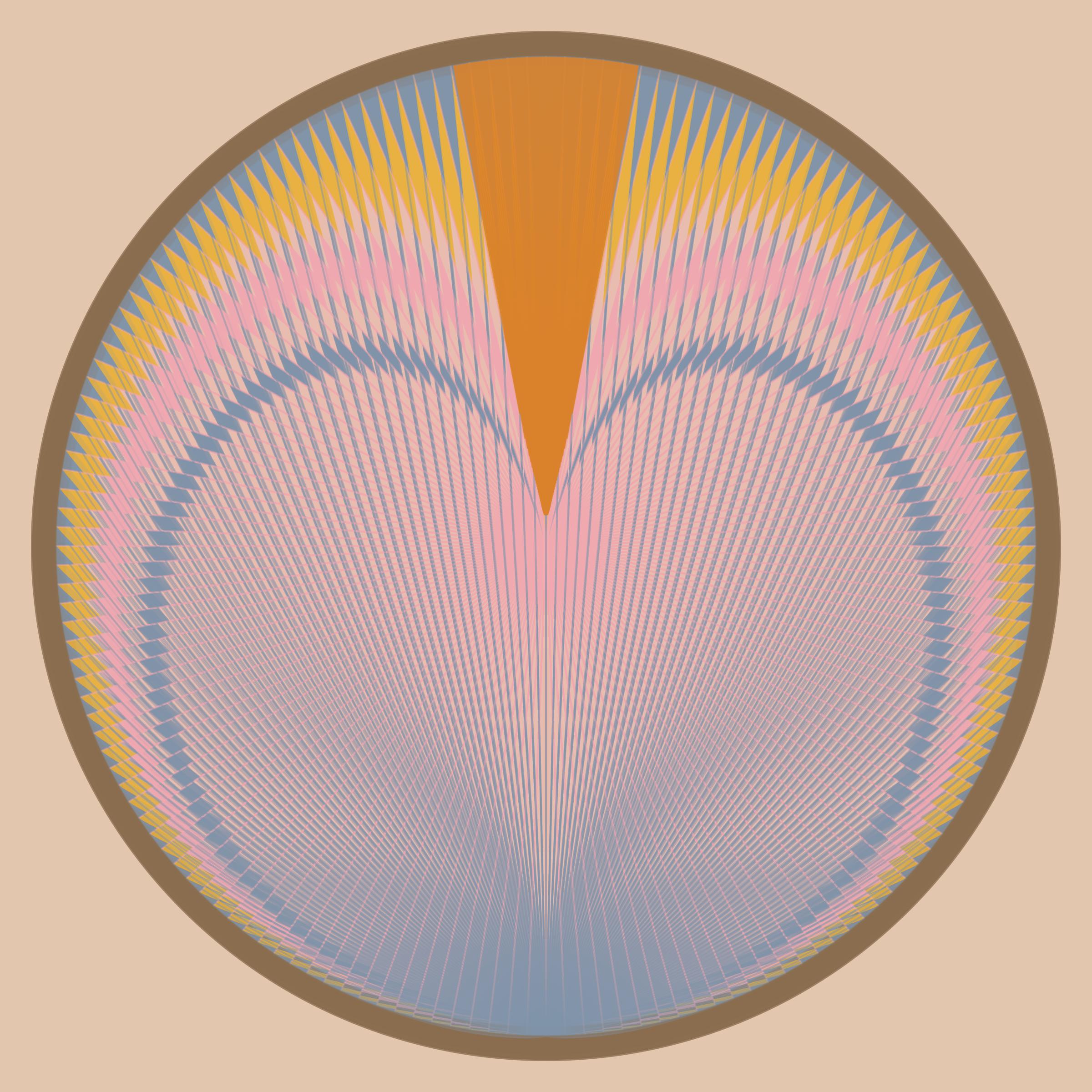
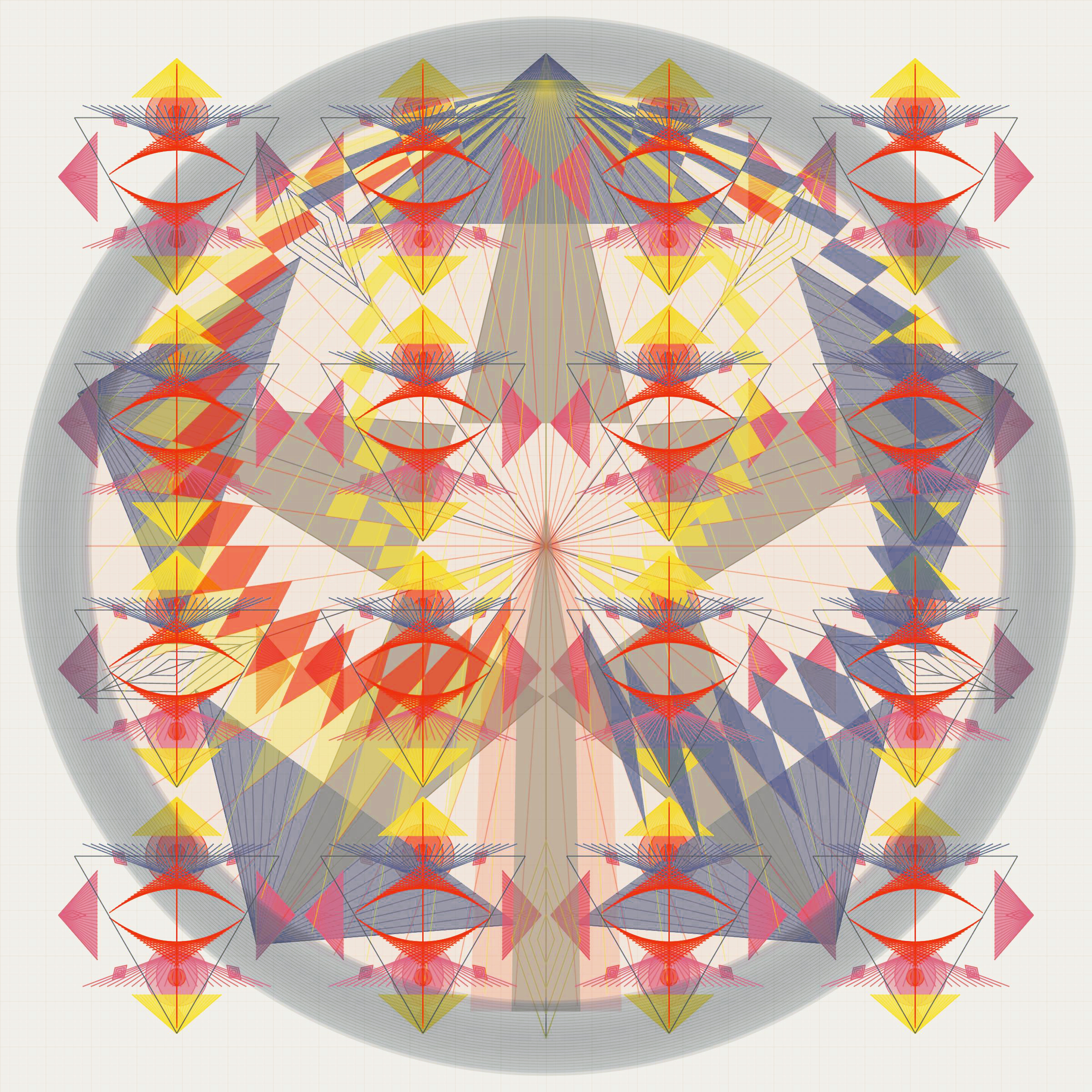
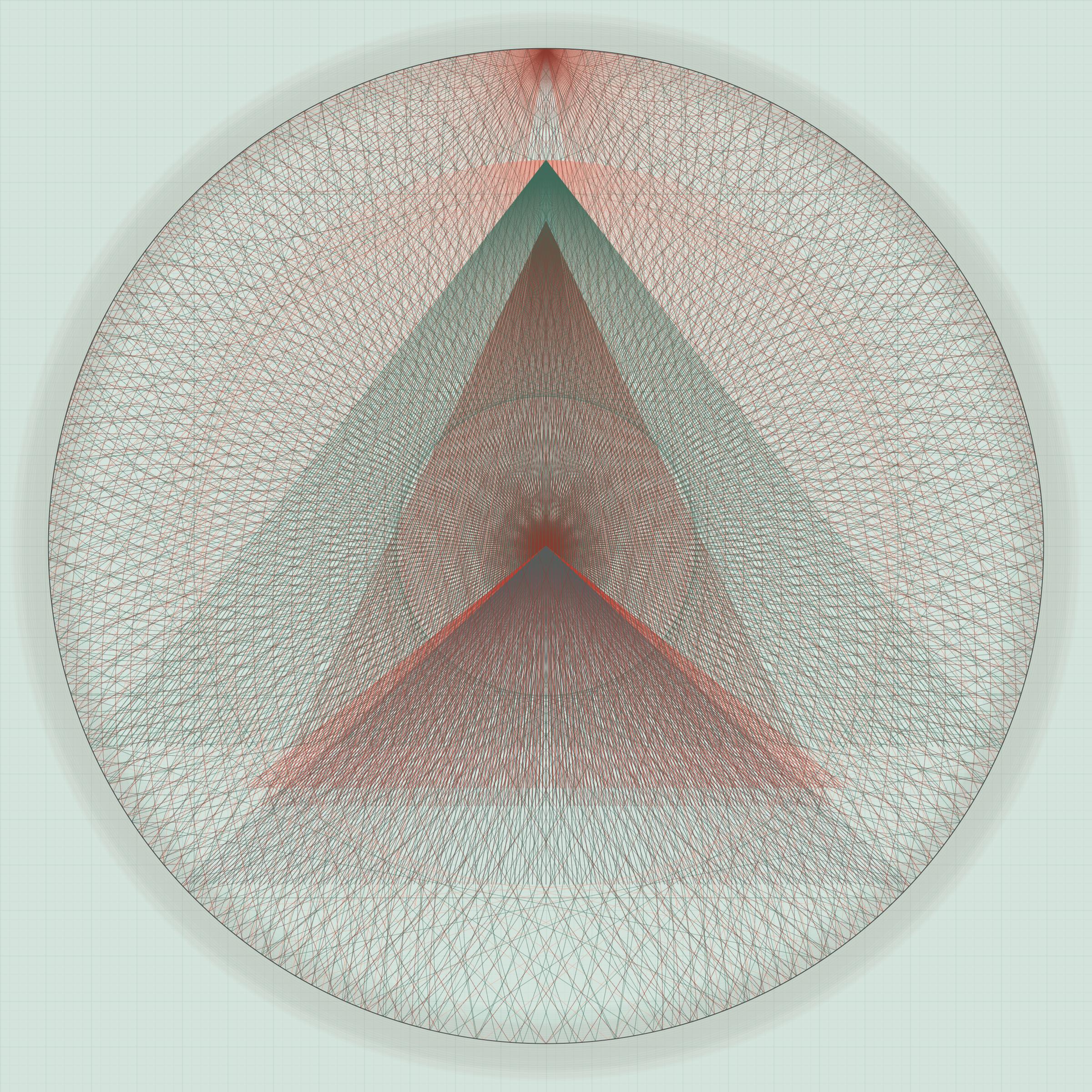
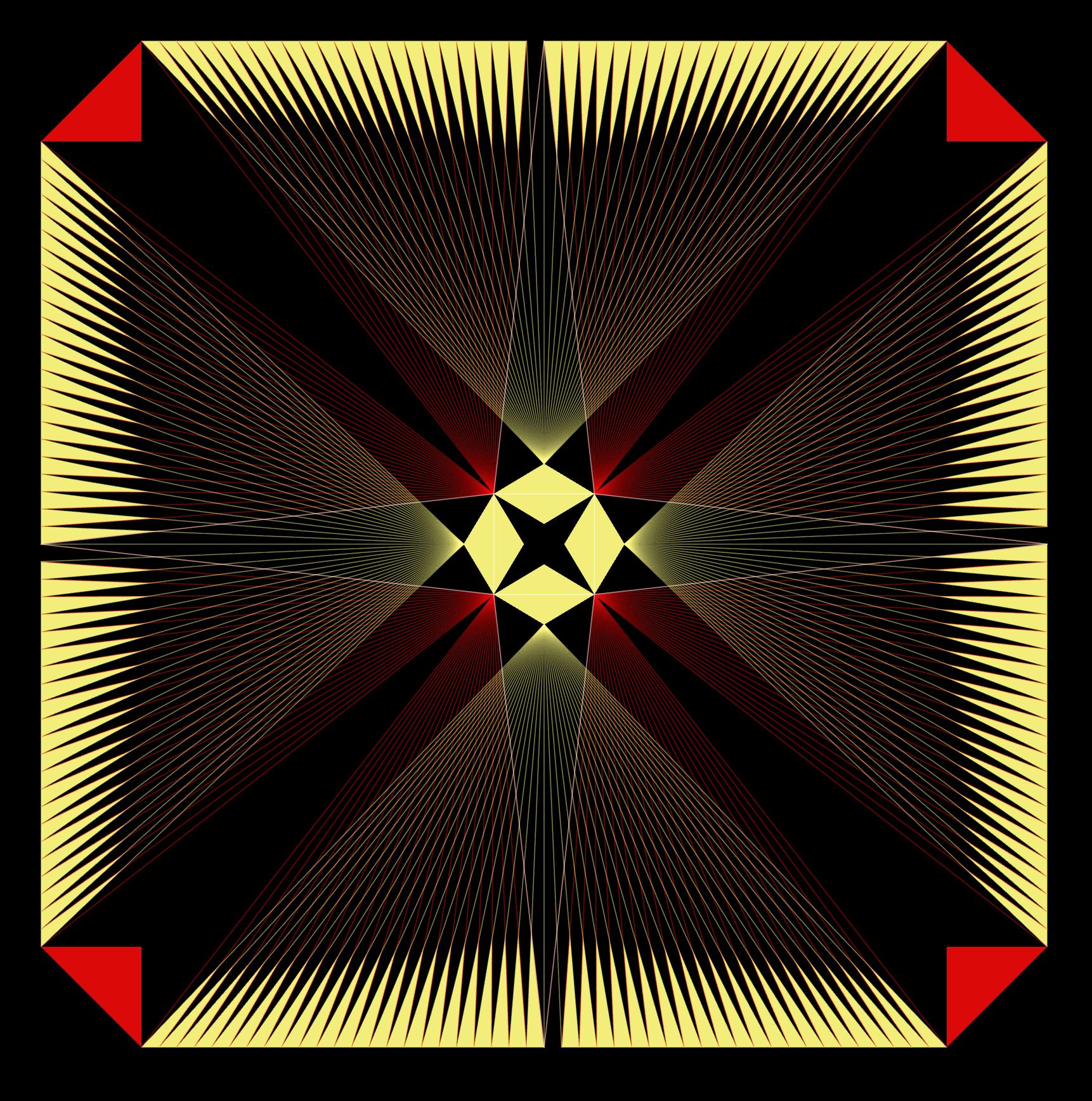
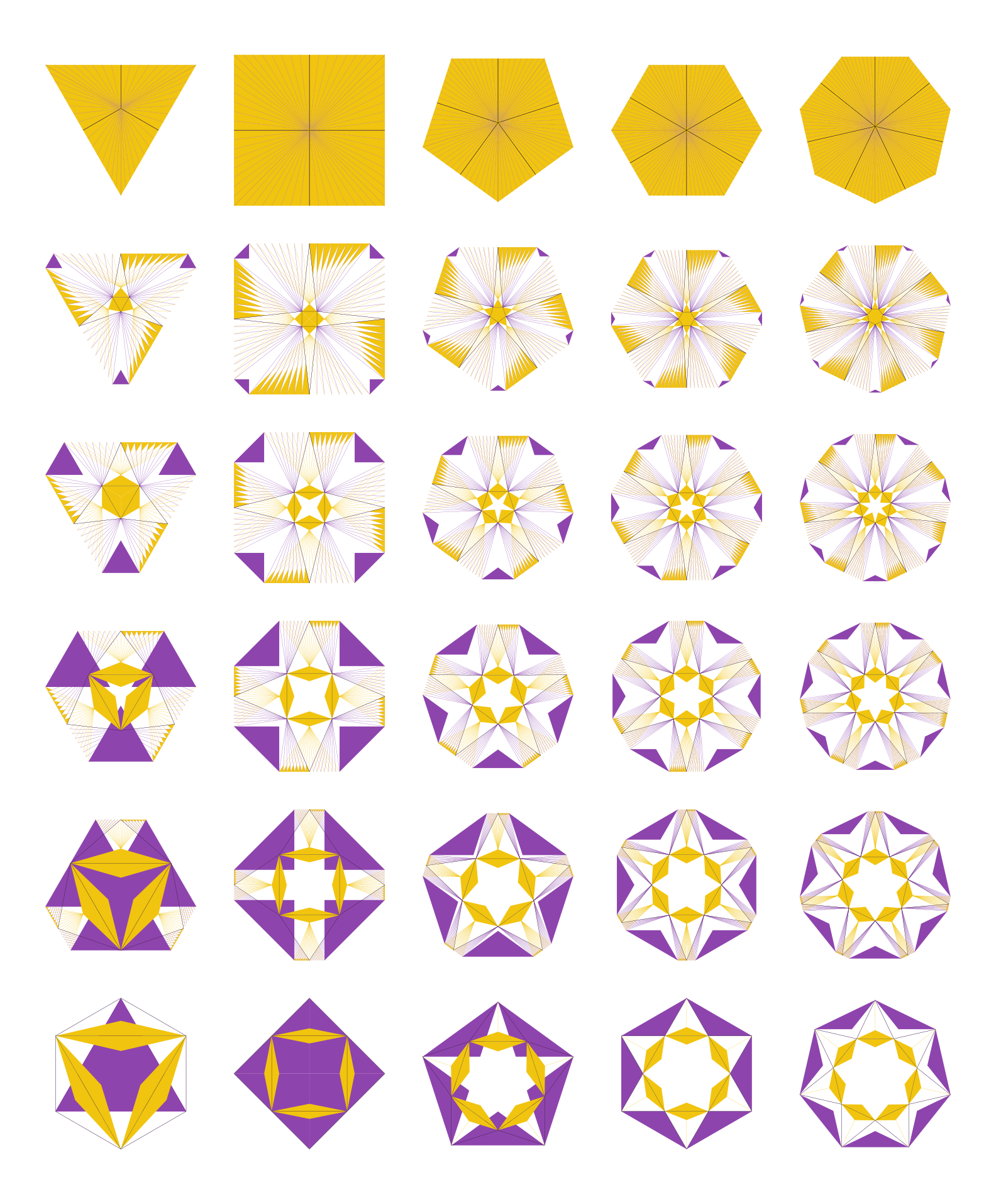
- Parametrizing. I open those constructions into a whole family of drawings. A handful of settings, such as point count, symmetry and fill, span a space of figures, most of which Kunz never made.
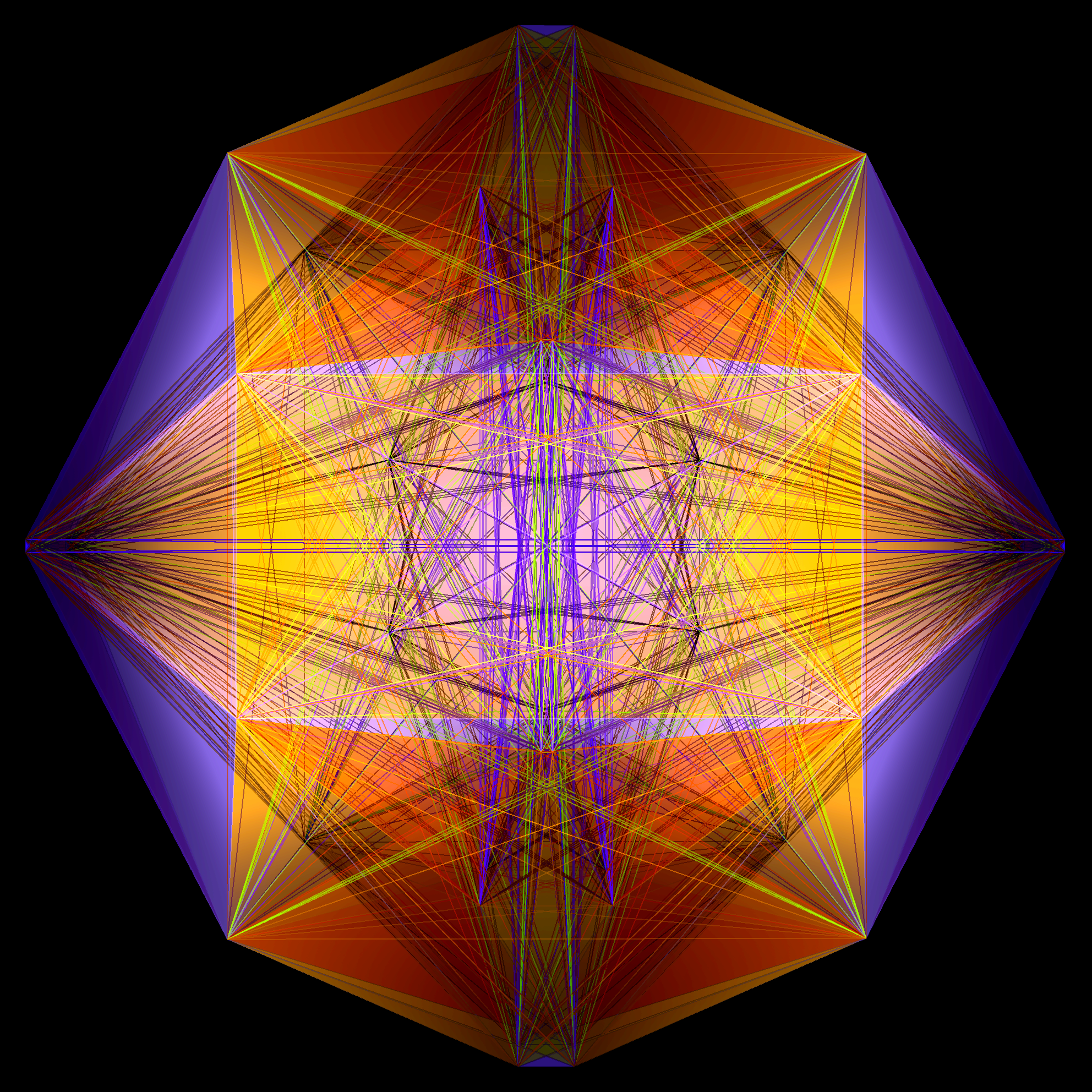
- The third dimension. I let the figure leave the plane. Points on paper become points in space, and every viewing angle projects a different drawing from the same object.
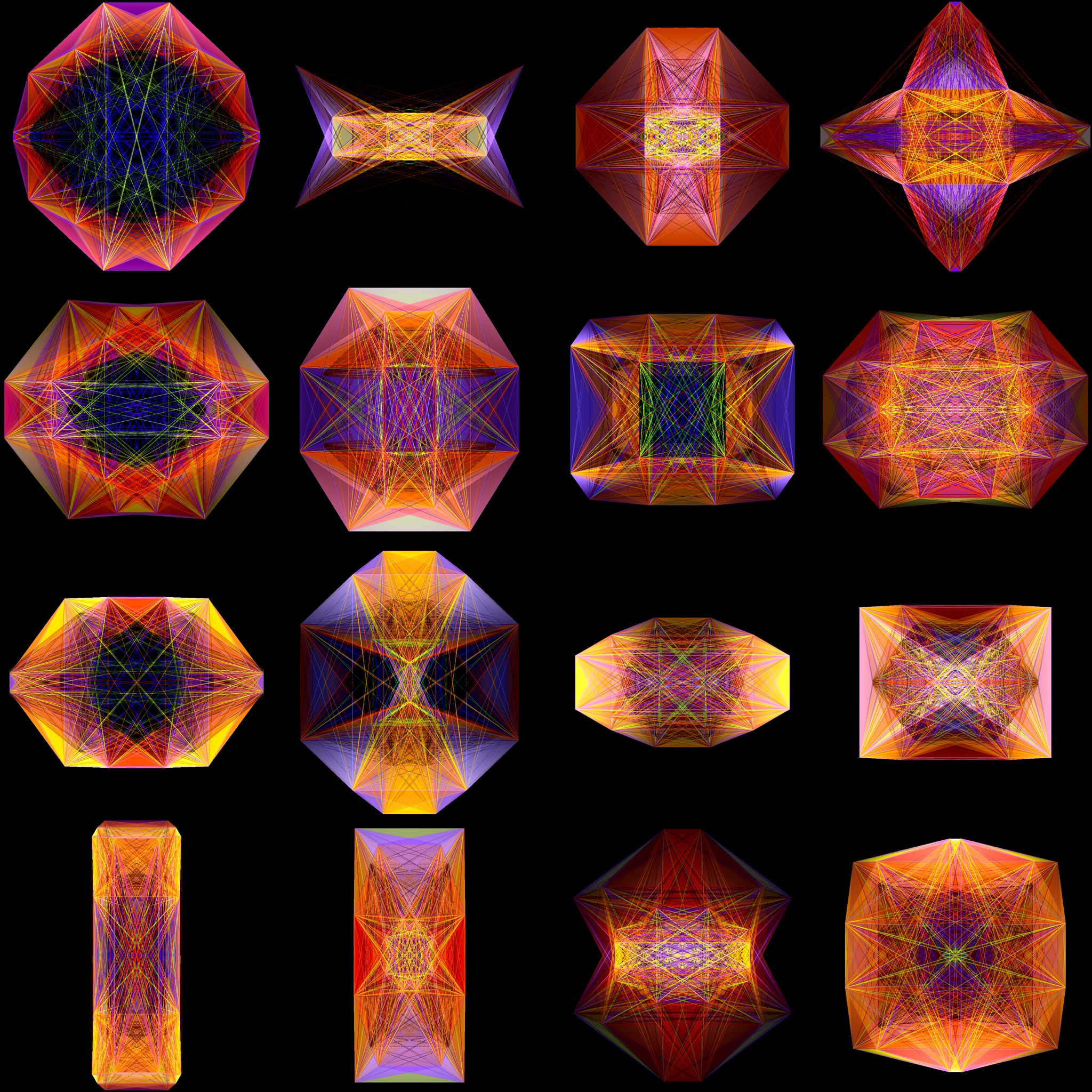
- The fourth dimension: time. I set the points moving. The structure that connects them stays fixed, but every face re-shapes as the points travel, so a single object becomes an endless sequence of forms. All of this runs entirely on the GPU as shaders, holding a full 120 frames per second on modern hardware, even on a phone.
The editor
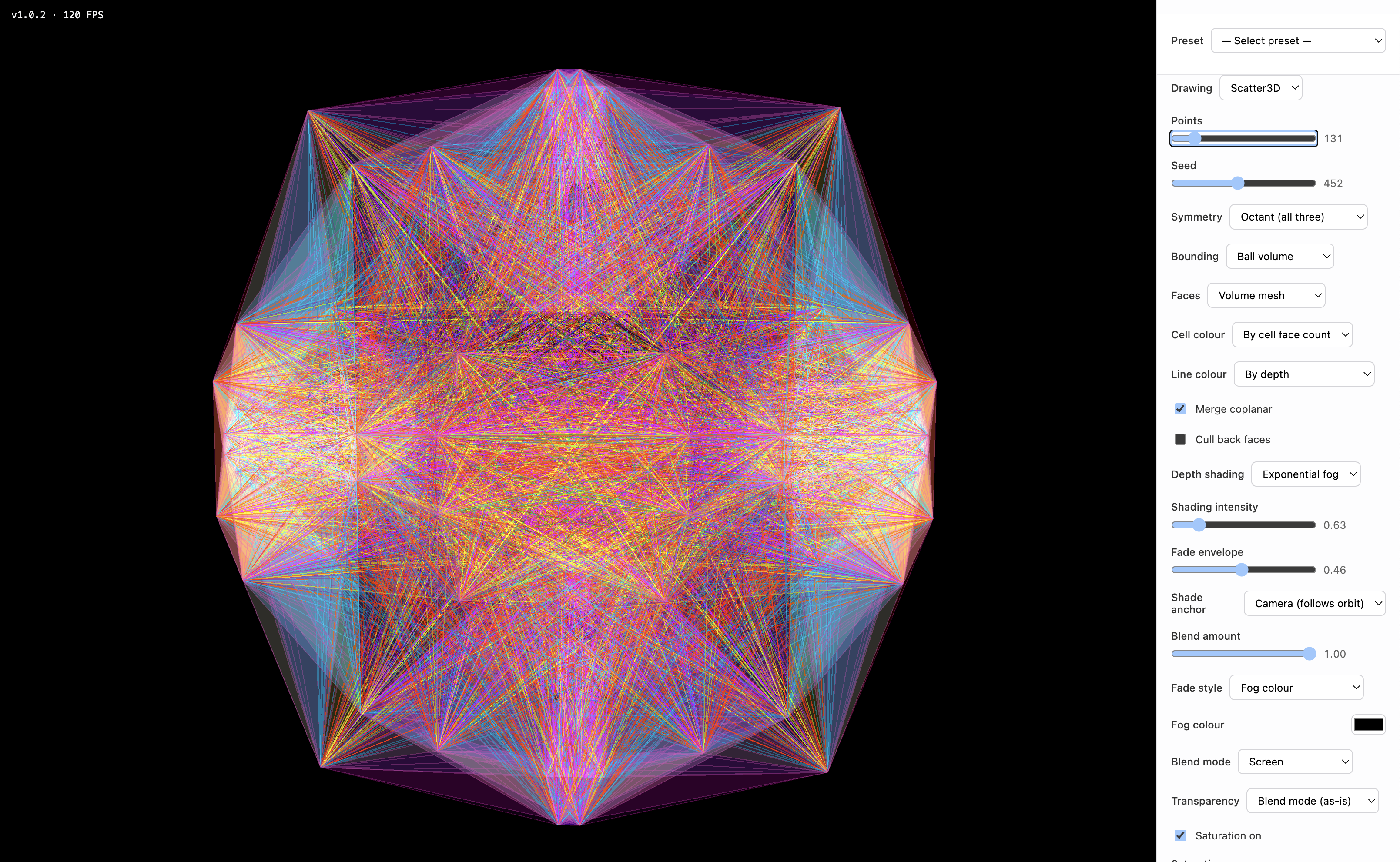
Behind the finished works sits a console I built for myself. It does not shape the composition; that is fixed elsewhere, by the seed and the block hash. What I steer here is everything laid over that structure: the complexity of the figure, its shading, its palettes, and the different ways the slivers that open up between intersecting lines are filled. Unlike the composition, which the block hash re-folds every twelve seconds, these settings are fixed once and never move. They are the constant character of a work, the traits that stay the same through every reconfiguration and set one token apart from the next. Where the block hash gives a work its endless motion, the editor gives it its identity. For now what ships is never this console, only its output: the eight exhibition works are configurations I fix here, one careful setting of every dial. I am not certain yet, but the editor may itself become public-facing one day, opening these dials to whoever holds a token.
Fully on-chain, alive with the network
I built Entfaltung to live entirely on the Ethereum blockchain. It is fully on-chain and fully deterministic: no server, no stored image, no external randomness. I compute the form at any instant from the state of the chain alone.
A new Ethereum block arrives roughly every twelve seconds, and I let each block reconfigure the work. The block hash re-folds the same structure into a new shape, so the drawing advances in step with the network itself.
I keep the reconfiguration topological. Topology is the study of what stays the same in a shape when it is stretched or bent, but never cut or glued. A token’s points, and the connections between them, never change. Only their positions move. Every block deforms the figure without ever tearing it: the same object, folded into a new shape. That invariance is the title. Entfaltung is one structure appearing in endless configurations while remaining, topologically, identical to itself.
I place this in the lineage of Manfred Mohr, who from the 1970s rotated a rigid n-dimensional hypercube and projected it to the plane, drawing endless images from one fixed set of vertices and edges. I keep his invariant but move the change inward. Mohr’s object stays rigid and only its orientation turns; here I let the points themselves travel, so the object genuinely deforms rather than merely rotating.
The pendulum and the chain
Emma Kunz worked her pendulum to get her own will out of the loop. She posed a question, read the swings as points and directions, and let the figure assemble itself from what the pendulum dictated. She understood the readings as coming from a higher order, a source outside her deciding mind. Read a century later, that source looks like the shape of a collective unconscious: a shared substrate of form that no single person authors, but any attuned instrument can pick up.
I keep her mechanism and relocate the source. In place of the pendulum I consult the Ethereum blockchain, itself a higher source of truth held in common: one ledger of state that every participant agrees on and no one controls. Each new block is a fresh reading, shared across the whole network at the same moment. The block hash is its swing of the pendulum. The order that shapes the work is real, the same for every observer, and authored by no one.
The release
I am considering to release Entfaltung in two parts.
Eight exhibition works, which I hand-curate and configure myself. Each of the eight is complex and singular, intended for institutional collectors, and shown as live computation.
A long-form NFT drop, with which I open the series to a wider audience. I seed each token in the drop from the moment and place of its mint, read astrologically. The mint time and location fix a birth chart for the token, and that chart sets its starting configuration once, the instant it comes into being.
For now the animation is a coloured construction on a black background, but I am still building diversity into the collection, so that the drop and the eight pieces each arrive with their own appearance and their own aura, rather than a single shared look.
On paper
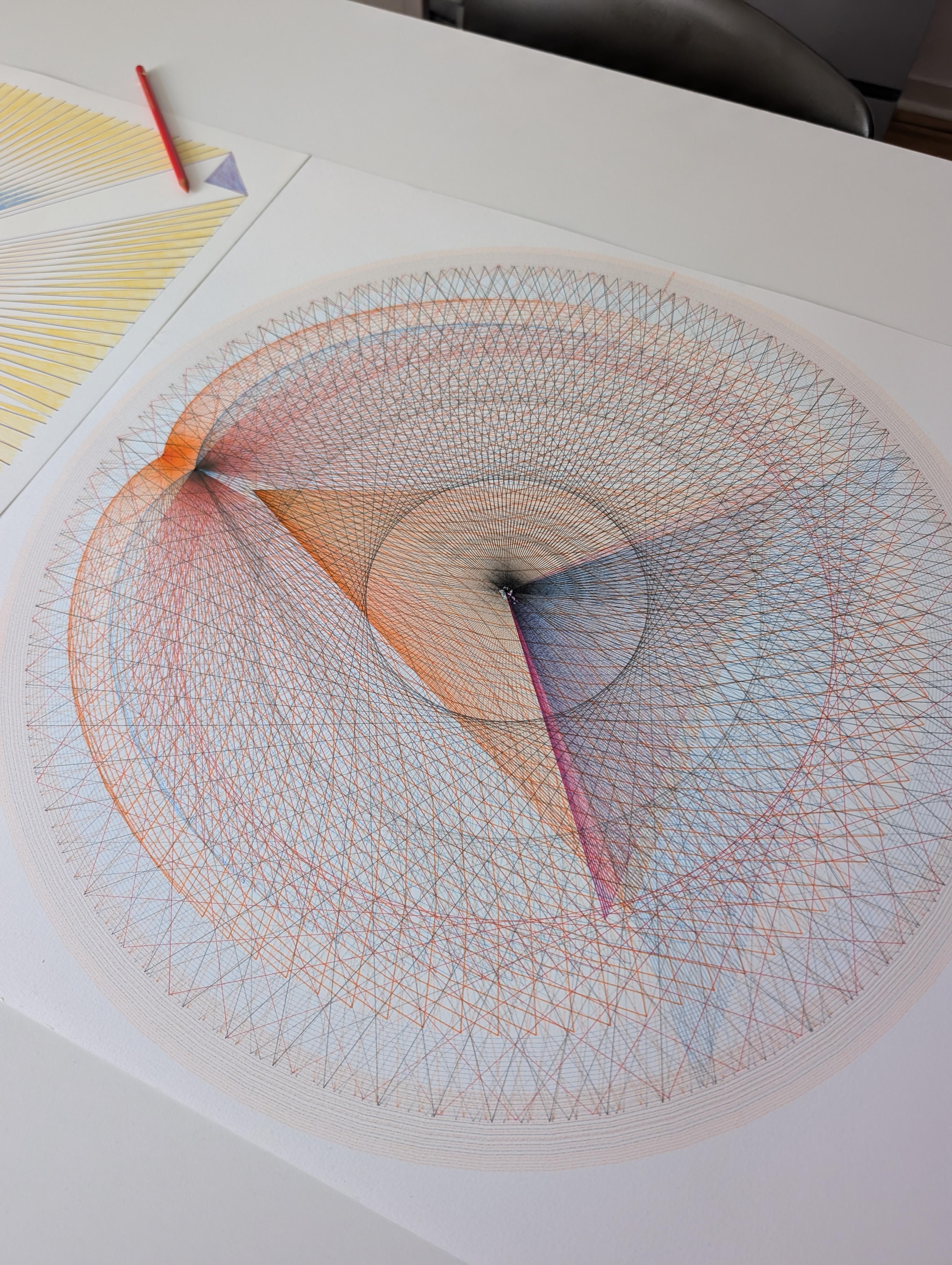
Alongside the on-chain releases I am making a series of plotter drawings, returning the work to the paper it came from. A pen plotter draws the line construction directly onto the sheet, and I then fill the slivers by hand in coloured pencil. Each one is part machine, part hand.